 The Republic of Azerbaijan
 .png)
High-level panel discussions on migration and cities held within WUF13
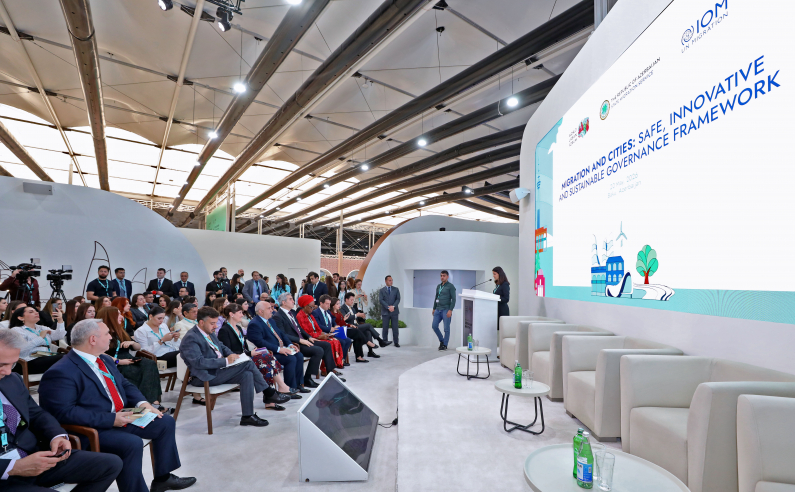
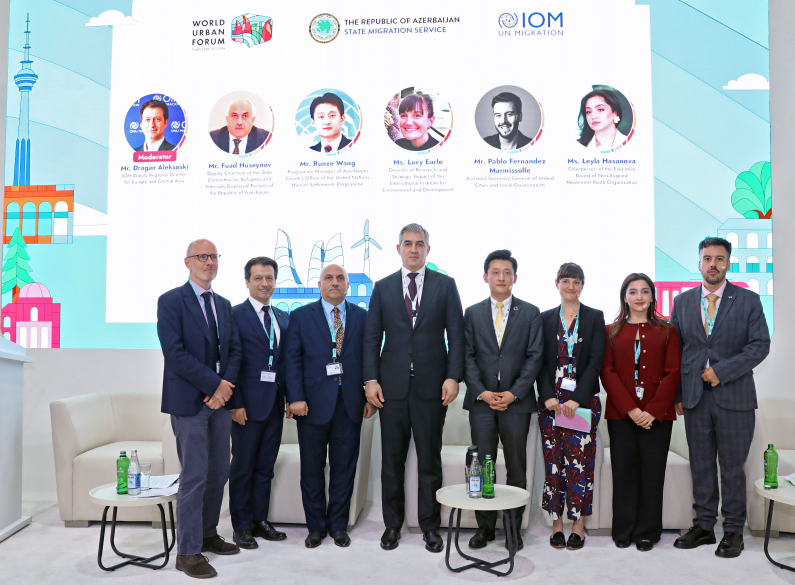
Within the framework of the 13th Session of the World Urban Forum (WUF13) in Baku, a high-level panel discussion on the theme “Migration and Cities: Safe, Innovative, and Sustainable Governance Framework” has been held at the Azerbaijan Pavilion, with joint organization of the State Migration Service and the International Organization for Migration (IOM).
The purpose of the high-level panel discussions, organized with the participation of government agencies, international organizations, local government authorities, academic circles, civil society, youth, and community members, was to raise global awareness of the impact of migration and urbanization processes on the sustainable development of cities and to promote international cooperation.
It should be noted that the panel discussions followed up the event on “Safe, Inclusive, and Sustainable Cities in the Age of Migration – Towards WUF13” which was jointly organized by the Republic of Azerbaijan, the IOM, and the UN Human Settlements Programme (UN-Habitat) within the framework of the second International Migration Review Forum held at the United Nations Headquarters on May 5-8 of this year.
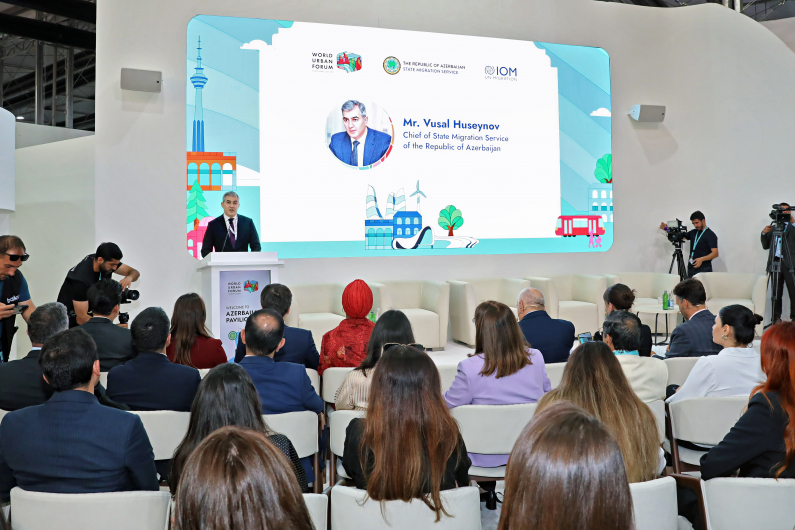
Delivering the introductory speech at the event, Vusal Huseynov, Chief of the State Migration Service, II rank state migration service counselor, stated that it is a source of pride for our country to host another global event of similar scale following COP29. He emphasized that the holding of WUF13 in Baku is a clear example of our country’s contribution to the global dialogue on sustainable urbanization and inclusive development.
Speaking about the increasing dynamics of migration, Vusal Huseynov emphasized that cities are the places where migration is most visibly felt. He noted that in cities, people more openly express their search for broader opportunities, services, education, and inclusivity. Vusal Huseynov highlighted that these characteristics make cities the center of migration processes and stressed the importance of studying the interconnections between urbanization and migration more deeply.
The Chief of the Service stated that, as the host of WUF13 and the co-chair of the Champion Countries Initiative for the implementation of the Global Compact for Safe, Orderly, and Regular Migration for current year, Azerbaijan attaches special importance to strengthening the synergy between the international frameworks regulating migration and urban planning issues.
Vusal Huseynov stated that Azerbaijan applies approaches in migration management that take into account the essence of the interconnections between urbanization, migration, and development. He emphasized that the return process of former internally displaced persons, carried out within the framework of the “Great Return” Programme launched after the liberation of our lands from occupation, accompanied by the construction of smart and sustainable cities based on modern urban planning principles, serves as an example of these interconnections.
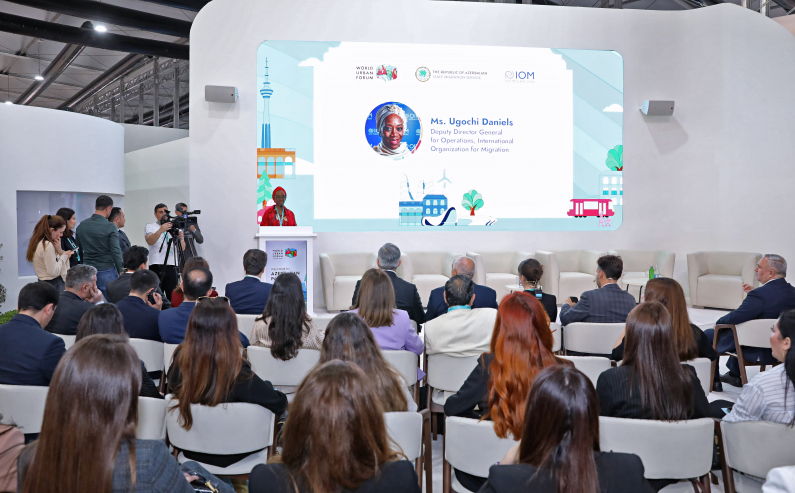
Later, Ugochi Daniels, Deputy Director General of the International Organization for Migration, highlighted the connection between migration and urbanization processes and emphasized the importance of joint cooperation and coordinated policies in this field
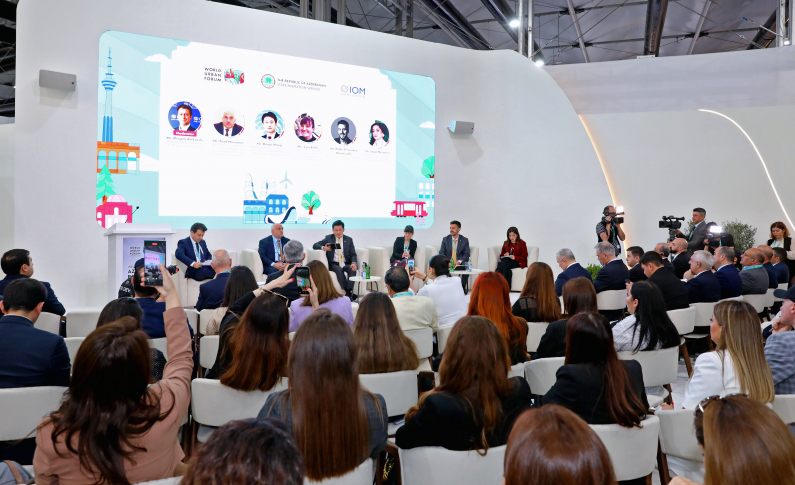
Afterwards, the panel discussions commenced. At the panel discussions held under the moderation of Dragan Aleksoski, IOM Deputy Regional Director for Europe and Central Asia, Fuad Huseynov, Deputy Chairman of the State Committee for Refugees and Internally Displaced Persons of the Republic of Azerbaijan, Runze Wang, Programme Manager of the UN-Habitat Country Office in Azerbaijan, Lucy Earle, Director of Research and Strategic Impact at International Institute for Environment and Development, Pablo Fernandez Marmissolle, Assistant Secretary General of United Cities and Local Governments and Leyla Hasanova, Chairperson of the Executive Board of the Non-Aligned Movement Youth Organization participated as panel speakers.
During the discussions, presentations on topics such as the impact of migration and rapid urbanization on cities and the challenges arising in this area, inclusive governance, the importance of coordination between national and local agencies, integrated urban strategies and best practices supporting safe housing, dignified return and sustainable solutions for those subjected to forced displacement, youth’s contribution to building inclusive cities, the contribution of research on migration-urbanization nexus to inclusive and sustainable urban policies, successful urban practices and international partnerships, were received with interest.